Remote Assistance and Monitoring: A Checklist to Prevent Downtime Upon Return
In the world of industrial automation, getting a system back online often depends on the ability to respond quickly, before a minor alarm turns into a costly machine shutdown. Remote support, combined with continuous monitoring, has become the first line of defense. In this article, we offer a practical checklist—enhanced by Mect solutions—to ensure that when workers return to the factory, the machines are operational, safe, and ready to produce.
1. Checking Network Connectivity
- Check the status of the interfaces (Ethernet, Wi-Fi, 4G) and latency.
- Ping tests to critical devices to confirm connectivity.
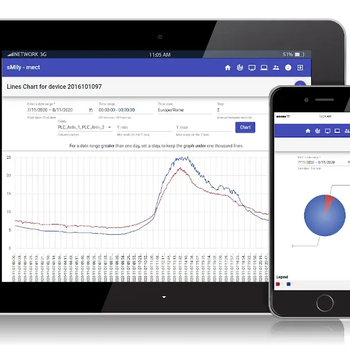
- Mect sMily provides a real-time overview of connectivity, with automatic alerts when the connection drops, allowing you to take action before the problem spreads.
2. Status of Sensors and I/O Modules
- Verification of temperature, pressure, and current values against operating thresholds.
- Check the digital inputs/outputs (0–24 V) to ensure there are no short circuits or abnormal signals.
- The 19-inch Linux Web Panel (WEBP4190), with its 8 configurable GPIO lines, allows you to view all I/O signals on a single screen, with integrated trend graphs powered by Grafana and InfluxDB.
3. Log Storage and Integrity
- Make sure the overlay file system is enabled (default on WEBP4190) to protect the logs from unexpected shutdowns.
- Check for alarm logs , PLC event logs, and diagnostic messages.
- With Mect Suite SDK , you can create custom scripts in Python or C/C++ that automatically extract logs and send them to the cloud via MQTT or OPC-UA.
4. Firmware and Application Updates
- Check the current firmware version of the PLCs, HMIs, and panels.
- Schedule the installation of critical updates during maintenance windows.
- Thanks to sMily, updates can be deployed remotely, with built-in checksum verification to prevent corrupted installations.
5. Monitoring System Resources
- Monitor CPU, RAM, and eMMC memory usage to identify bottlenecks.
- On the WEBP4190, the Linux kernel with real-time support alerts you to any spikes in usage that could compromise the HMI's responsiveness.
- Use Node-RED or Python scripts to set alarm thresholds and configure notifications via email or instant messaging.
6. Security and Access
- Verify that remote access credentials (VPN, SSH, certificates) are up to date and have not expired.
- Check the access logs to detect intrusion attempts.
- Mect Suite allows you to manage users with different roles, restricting access to authorized personnel only.
7. Emergency Response Drill
- Perform a fault simulation (e.g., loss of sensor signal) to verify that the remote assistance procedures are triggered automatically.
- Confirm that the support team receives the alert, logs into the system via sMily, and initiates the resolution process.
8. Documentation and Communication
- Update the maintenance log with the tasks performed during the inspection.
- Send a summary report to the production manager, including any corrective actions.
- Mect's "Request a Quote" form can be used to request a personalized consultation or a demo of the new monitoring features.
How Mect Solutions Make Checklists More Effective
| Solution | A key benefit of remote support |
|---|---|
| Mect Suite (IDE, SDK) | Rapid development of integrated HMIs/PLCs; custom diagnostic scripts in Python, C++ or Node.js |
| sMily – Remote connection and monitoring | 24/7 access from anywhere; push notifications and automatic reports |
| Web Panel 19’’ Linux (WEBP4190) | 19-inch display for viewing complex synoptic diagrams, energy trends and real-time alarms; native support for MQTT, OPC‑UA, Docker and filesystem overlays |
Conclusions
Proper remote assistance is not just a “periodic check,” but an ongoing process of monitoring, preventive diagnostics, and rapid response. By following the suggested checklist and utilizing the Mect platforms— sMily, Mect Suite, and the 19-inch Linux Web Panel —it is possible to drastically reduce machine downtime, increase system availability, and improve the competitiveness of the entire production line.
If you'd like to learn more about how to implement these practices in your company, please contact the Mect team or filloutthe“Request a Quote”form. We’re ready to offer you a personalized demo, assess your specific needs, and work with you to build the remote assistance solution best suited to your industrial context.
The future of automation is connected, proactive, and seamless: choose Mect, choose continuity.