Industrial Automation 5.0: How Factories Are Changing with AI and Collaborative Robots
by MectThe industry is experiencing an epochal revolution, known as Industry 5.0. This new era does not simply improve existing processes, but radically transforms them, integrating artificial intelligence, collaborative robotics and advanced automation solutions. Mect, a leading Italian company in the production of devices for industrial automation, is at the center of this transformation, offering innovative solutions that are redefining the future of manufacturing.
The Dawn of a New Industrial Age
Technological evolution has always marked the path of industry, bringing innovations that radically transform the way we produce and work. After the fourth industrial revolution, characterized by automation and smart factories, today we are facing a new frontier: Industrial Automation 5.0. This phase is characterized by the synergic integration of Artificial Intelligence (AI) and collaborative robots, redefining the very concept of factory and introducing an era of unprecedented human-machine collaboration.
The Evolution of Industrial Revolutions
To fully understand the impact of Industrial Automation 5.0, it is essential to look back. The first industrial revolution, driven by the steam engine, replaced manual labor with steam-powered machines. The second, thanks to electricity, brought mass production and assembly lines. The third revolution, with the advent of information technology and automation, introduced robots and control systems.
The fourth industrial revolution, or Industry 4.0, integrated the Internet of Things (IoT), Big Data, and cyber-physics, creating interconnected and intelligent factories. Now, Industry 5.0 goes further, focusing not only on efficiency and automation, but also on the joint work of humans and machines, improving customization and sustainability.
The Role of Artificial Intelligence in Industry 5.0
AI is no longer confined to repetitive tasks; it has become the beating heart of industrial operations. Through machine learning algorithms, AI analyzes data in real time, optimizing processes such as predictive maintenance, quality control, and supply chain management. For example, predictive maintenance systems use IoT sensors to monitor the health of equipment, predicting failures before they occur and reducing downtime.
In supply chain management, AI predicts demand and optimizes inventory, reducing costs and improving efficiency. This real-time adaptability not only reduces risk, but also allows for greater flexibility in production, allowing companies to respond quickly to market changes.
Collaborative Robots
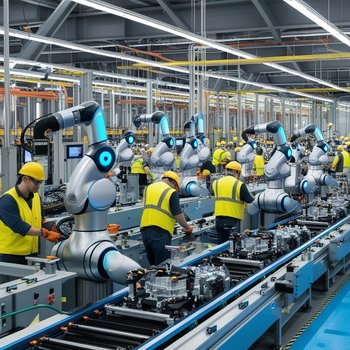
Cobots, or collaborative robots, are revolutionizing the way factories operate. Unlike traditional robots, which are isolated in their work areas, cobots are designed to work alongside humans in complete safety. Thanks to advanced sensors and machine learning algorithms, these robots can adapt to human movements, collaborating on tasks that require precision and flexibility.
In manufacturing environments, cobots are used for tasks such as assembly, welding, and component assembly. Their ability to learn from human operators improves product quality, reduces errors, and increases efficiency. This collaboration not only optimizes processes, but also reduces the physical workload for operators, improving safety and well-being in the workplace.
Sustainability and Environmental Impact
Industry 5.0 focuses not only on production efficiency, but also on environmental sustainability. Advanced technologies such as AI and cobots allow to optimize the use of resources, reducing waste and emissions. For example, AI can optimize energy consumption by identifying areas of inefficiency and proposing solutions to reduce waste.
Factories of the future will be able to integrate renewable energy, such as solar or wind, and implement smart grids to manage energy more efficiently. This approach not only reduces the carbon footprint, but also helps create a more circular economy, where materials and resources are reused and recycled.
Mect Products: Technology at the Service of Innovation
Mect develops advanced solutions for industrial automation, including:
- PLC with Digital and Analog Inputs-Outputs: Controllers that guarantee flexibility and reliability in control systems.
- HMI Operator Panels: Intuitive user interfaces that integrate PLC and I/O for simplified process management.
- Single Board Computer (SBC): Compact and powerful boards, designed for embedded applications, with Linux (Raspbian) operating system, ARM processors, HDMI output and extensive I/O interfaces.
These SBCs are ideal for integration into panels, electrical cabinets, edge devices and IIoT gateways, offering a fanless design for use in harsh industrial environments.
AI and Machine Learning Integration: The Future is Now
Mect Single Board Computers integrate TensorFlow Lite and Edge Impulse, powerful tools for AI model inference and ML model creation from sensor data. This capability enables the implementation of intelligent solutions to monitor and optimize industrial processes, such as defect recognition, failure prediction, and resource utilization optimization.
Advantages and Future Prospects
Integrating AI and ML into Mect devices offers numerous benefits, including:
- Improved Efficiency: Optimized processes through predictive analytics and real-time adaptation.
- Reduced Costs: Less need for maintenance and preventative interventions.
- Flexibility: Systems that can be customized to meet specific needs.
- Continuous Innovation: The ability to implement new algorithms and models ensures constant evolution.
Mect and the Future of Automation
Mect is not just a technology provider, but a pioneer in Industry 5.0. The company's advanced solutions are shaping the future of manufacturing, making factories smarter, more efficient and connected. With Mect, the industry can fully seize the opportunities offered by AI and collaborative robotics, creating a future where humans and machines work together to achieve extraordinary results.