Behind the Scenes of Made in Italy: From Concept to Custom Electronic Circuit Board for the OEM
At the heart of Italian industry today, excellence is also measured in microns, lines of code, and printed circuit boards that—like a work of art—emerge from an idea and take shape thanks to a highly specialized supply chain. In this article, we’ll take you on a journey that begins with brainstorming and ends with the delivery of a custom electronic circuit board, ready to enter mass production for an OEM. Thanks to Mect, this entire process can take place entirely in Italy, with a guarantee of quality, innovation, and ongoing support.
1. The idea takes shape: defining the functional requirements
The first step in any project is to understand the customer’s vision: What data does the customer need to collect? What actuators does the customer need to control? What is the operating environment (industrial, agricultural, automotive, food & beverage)?
At Mect, our Research & Development engineering team (62 % of the dedicated staff) works closely with the customer to translate these needs into a technical specification document. The following are defined in this document:
- Required I/O (digital, analog, relays, terminal blocks);
- Connectivity (Wi-Fi, Bluetooth, Ethernet, fieldbus);
- Space constraints and safety standards (CE, UL, IEC 61131-3);
- Software features (PID control, logging, alarms, HMI interface).
This phase is crucial because it determines the selection of the most suitable hardware platform.
2. Choosing a Platform: Mect’s Namino Ecosystem
For many industrial automation solutions, the Namino platform is the ideal starting point. It is a system of ESP32-based electronic boards, entirely Made in Italy, that combines:
- Integrated input/output (industrial terminal blocks and relays) on side A, for quick and safe wiring in harsh environments;
- Arduino UNO compatibility on the B side, allowing you to take advantage of the vast ecosystem of available libraries and shields.
The Namino Rosso, Arancio, and Bianco variants offer different I/O configurations, but they all share the same dual architecture. This means that, even during the prototyping phase, you can transition from a familiar development environment (Arduino IDE or VS Code with PlatformIO) to a solution ready for factory installation without having to redesign the PCB.
3. Custom Hardware Design
Once the base platform has been selected, Mect’s hardware design team begins designing the framework for the custom board. The tasks include:
- Schematic: Integration of ESP32 modules, power drivers, overvoltage protection, and EMI filtering.
- PCB Layout: Optimizing component placement to reduce interference, ensure effective heat dissipation, and meet the customer’s dimensional requirements (for example, 48 × 48 mm or 48 × 96 mm for our MPCT20 M1 and MPCT301 P6 industrial pulse counters ).
- Choice of connectors: screw terminal blocks for industrial installation; headers compatible with Arduino shields for the testing phase.
During this phase, Mect uses advanced simulation software and, thanks to its in-house production line, can quickly produce prototypes for field validation.
4. Firmware and Software: From Code to the Finished Product
At the heart of every board is the firmware that manages the control logic. Mect offers three development modes, designed to accommodate the customer's level of autonomy:
| Modalità | Descrizione | Vantaggi |
|---|---|---|
| Lo sviluppiamo noi | Il team Mect si occupa di hardware, firmware e interfaccia utente, rilasciando il codice sorgente al termine | Tempo di sviluppo ridotto, competenze di alto livello, unico referente |
| Lo sviluppiamo insieme | Sessioni private (remoto o in sede) con un tecnico Mect, pacchetti da 5 o 10 ore | Trasferimento di know‑how, personalizzazione al 100 % |
| Supporto iniziale | Un’ora gratuita di consulenza per impostare il progetto, poi autonomia totale | Costi contenuti, avvio rapido |
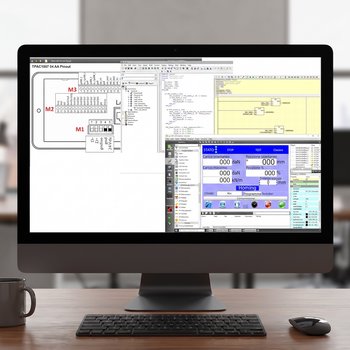
For Namino solutions, the firmware can be written in Arduino C/C++, utilizing the Wi-Fi/Bluetooth libraries built into the ESP32 and Mect’s APIs for managing industrial terminal blocks. For more complex applications (PLCs, advanced HMIs), we use our sMily development environment, which enables real-time monitoring and remote connection for debugging.
5. Rapid prototyping and field testing
Once the firmware is complete, we move on to manufacturing small batches (1 to 10 units) for the testing phase. Thanks to Namino’s modular design, it’s possible to quickly add additional shields (such as the Namino Nero Vac for controlling vacuum valves or the Namino Nero Vdc for DC power supplies) and verify performance under real-world operating conditions.
The MPCT20 M1 and MPCT301 P6 industrial pulse counters are often used as verification tools: with their 5 + 5- or 6-digit displays, it’s easy to view counts, RPM, frequencies, or timer readings, confirming that the counting logic is correct before moving on to mass production.
6. Mass Production: From One-of-a-Kind to Mass Production
Once the tests have been passed, Mect begins mass production of the custom board. Our mass production facility for electronic boards is certified to ensure:
- Consistent quality (statistical controls, automated functional tests);
- Component traceability (lot number, date of manufacture, RoHS certifications);
- On-time delivery thanks to a stockpile of key components and partnerships with Italian suppliers.
The OEM customer receives the boards ready for final assembly into their products, with the option to request brand-specific customizations (logo, PCB color, packaging).
7. After-sales support and product development
The journey doesn't end with delivery. Mect provides a remote monitoring service through the sMily platform, which allows you to:
- Update the firmware via OTA (over-the-air) to add new features or fix bugs.
- Monitor the board's status (temperature, supply voltage, communication errors).
- Respond quickly to alarms with push notifications on mobile devices.
In addition, our Research & Development team is constantly working on new technologies (IoT, edge AI, 5G communications) to ensure that our OEM solutions always keep pace with market developments.
8. A concrete example: automation of a vertical greenhouse
To give you a clearer picture of the process, let’s briefly describe the case of a vertical greenhouse for growing microgreens. The client wanted:
- Control temperature and humidity with an accuracy of 0.1°C.
- Manage irrigation based on soil moisture sensors.
- Monitor production through a web interface accessible via smartphone.
Mect proposed a Namino Arancio board with industrial terminal blocks for the ventilation relays and built-in Wi-Fi connectivity for the HMI interface. The firmware, developed in collaboration with the customer (using a “let’s develop it together” approach), managed a PID algorithm for climate control and sent data to a cloud-based dashboard. MPCT301 P6 pulse counters were used to count irrigation cycles and generate threshold alarms. Following the prototyping phase, mass production of 5,000 boards enabled the client to equip 200 cultivation modules, reducing energy consumption by 15% and increasing yield by 20%.
9. Conclusions: The Strength of "Made in Italy"
From the initial idea to the custom electronic board for the OEM, the process involves a series of technical decisions, design iterations, and rigorous testing. Thanks to Mect, every step is supported by in-house expertise, a flexible hardware platform (Namino), and customized software development services. The result is a “Made in Italy” product that combines industrial reliability, rapid innovation, and the ability to adapt to highly competitive markets.
If your company is looking for a partner to turn a concept into a production-ready electronic solution, please contact us. Together, we can bring your next automation project to life, with the quality assurance and pride of a truly Italian product.
To learn more about Namino solutions, MPCT pulse counters, or our custom development services, visit the Mect website or contact our team of experts. We’re ready to turn your idea into reality.